
The capsule wardrobe sounds like something invented for Instagram around 2016. It is a great deal older than that. The phrase belongs to Susie Faux, who opened her boutique Wardrobe in London’s West End in 1973 and spent years telling women to buy fewer, better things, and it went global when Donna Karan launched her Seven Easy Pieces collection in 1985.
In Short
- Start by wearing and recording, not by decluttering. Three weeks of notes beat any checklist.
- Around 30 to 40 pieces is the usual working range, adjusted for your climate and your job.
- One neutral base plus two colours you genuinely like is enough for the whole thing to combine.
- Fit and repetition matter more than the specific list of “essentials” any article gives you.
- 1 Where the idea came from, and why the history is useful
- 2 Do the audit by wearing, not by throwing out
- 3 How many pieces, realistically
- 4 The pieces that pull the most weight
- 5 Colour is what makes it a system
- 6 Where a capsule wardrobe falls down
- 7 Keeping it alive from one season to the next
- 8 The questions people ask me about capsules
Where the idea came from, and why the history is useful
Faux’s argument was about quality and coherence rather than minimalism, which is a distinction that gets lost now. She was not asking anyone to own as little as possible. She was pointing out that a small number of well-cut things you can wear in different combinations gets you dressed better than a full rail of nearly-right purchases.
Donna Karan’s 1985 collection made the concept legible: a bodysuit, a skirt, a tailored jacket, a dress, something in leather, a white shirt and a cashmere sweater. Seven items, built as a system, designed to be worn together in any order. That is the actual idea, and it explains why a capsule assembled from unrelated bargains never works no matter how good each individual piece is.
So the test for any garment is not “do I like it” but “what does this already go with”. A jacket that works with one skirt you own is a jacket that will be worn about four times a year.
Do the audit by wearing, not by throwing out
Spend three weeks recording what you actually wear before you remove a single thing. Photograph the outfit or note it in your phone, whatever takes ten seconds. What comes out of that list is far more honest than anything you would predict about yourself.
The patterns are usually uncomfortable in a helpful way. Most people find they are rotating around fifteen items while owning six times that, and that the things they think of as their style are not the things they reach for on a Tuesday morning.
Then, and only then, sort the rest into three piles: keep, repair or alter, and pass on. The alter pile is the one people skip, and it is where the value hides. A hem shortened or a waistband taken in costs a fraction of a replacement and rescues clothes you already chose once.
How many pieces, realistically
The 30 to 40 figure is a guide rather than a rule, and it usually excludes underwear, gym kit, accessories and anything for a wedding. Here is roughly how that breaks down for a UK climate, where you need layers for eight months of the year.
| Category | Rough count | What decides the number |
|---|---|---|
| Tops and shirts | 8 to 12 | How often you do laundry, and whether work needs a collar |
| Bottoms | 5 to 7 | Two jeans you love beat five you tolerate |
| Knitwear and layers | 4 to 6 | Climate, and how cold your office runs |
| Dresses | 2 to 4 | Whether you actually wear dresses, honestly |
| Outerwear | 2 to 3 | One waterproof, one smart, one warm covers most lives |
| Shoes | 4 to 6 | Commute, weather, and one pair for evenings |
The pieces that pull the most weight
A capsule earns its keep through the plain items, not the interesting ones. The list below is not sacred, but each of these combines with nearly everything else, which is the only qualification that counts.
- Straight-leg jeans in a dark, plain wash. They read smarter than a faded pair and go under everything. Getting the rise right for your proportions does more than the brand does, which is the whole point of choosing jeans for your body type rather than for the label.
- A white shirt that fits at the shoulder. Shoulder seams are the one thing a tailor cannot easily fix, so buy for that measurement and alter the rest.
- A simple dark dress. Not necessarily black, and not necessarily little. Something you can change the mood of with a jacket or boots.
- A trench or a well-cut blazer. Whichever one suits the weather where you live and the way you commute.
- Two or three neutral knits in different weights, because one thick jumper is useless in an overheated office.
Check the composition label before the price on anything you expect to keep for years. A wool blend with a little nylon through it survives a commute better than pure wool, elastane in denim gives comfort but goes baggy at the knee sooner than rigid cotton, and a viscose shirt drapes beautifully and creases if you look at it. None of that makes a fabric wrong, it just tells you what you are signing up for.
Colour is what makes it a system
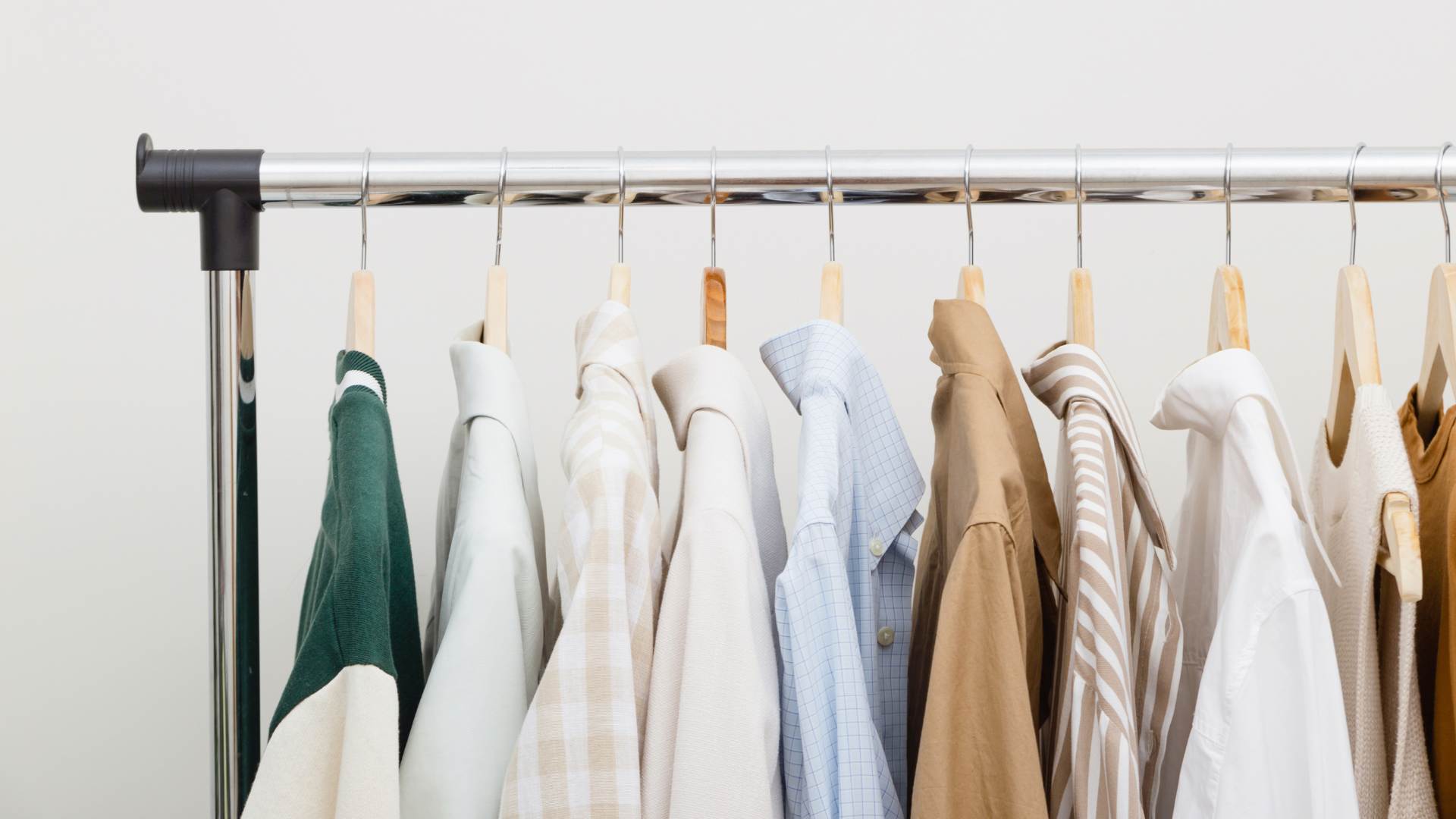
Pick one base neutral that everything sits on, in navy, black, grey, camel or olive, and then no more than two accent colours. That single decision is what turns a pile of clothes into a set of outfits, because it guarantees the bottoms and the tops agree with each other by default.
From my side of the makeup chair, the accent colours worth keeping are the ones that make your face look rested rather than the ones that look best on a hanger. Hold the fabric up under a window rather than shop lighting and watch what happens to the skin under your eyes. If it looks tired, the colour is wrong for you regardless of how good it is on someone else.
Where a capsule wardrobe falls down
It is not a solution for every life, and pretending otherwise is how people give up in month two. Jobs with a uniform or a dress code, bodies going through pregnancy or any other change, and anyone whose weekends look nothing like their weekdays all need more flexibility than a fixed list allows.
The other trap is turning the edit into shopping. Browsing a site like Net-a-Porter to build a mood board is genuinely useful for working out which silhouettes you keep returning to, and completely counterproductive if it ends with a basket full of replacements for clothes that were fine. Build the mood board, close the tab, then look in your own wardrobe first.
And a capsule is not automatically sustainable. Owning less helps only if you keep things longer, which comes down to repair, laundry habits and where you buy, not to the item count.
Keeping it alive from one season to the next
Review it twice a year rather than constantly, at the points where the weather genuinely changes. Look at what went unworn for a full season and ask whether it was the piece or the gap around it. A skirt nobody wears is often a skirt with no top that works with it, and one cheap tee fixes it.
Replace rather than accumulate. When something new comes in, something goes out, which keeps the numbers honest and stops the capsule quietly becoming a wardrobe again. Trend pieces are allowed under the same rule, and treating them as a small rotating layer over a stable base is exactly how the system was meant to work in the first place.
The questions people ask me about capsules
Does a capsule wardrobe mean everything has to be beige?
No. Neutral means coherent, not colourless. A base of navy with two strong accent colours is a capsule; a rail of oatmeal is just one aesthetic among many, and it happens to photograph well, which is why it dominates online.
How do I handle a job with a strict dress code?
Run two small capsules that share the same base neutral and the same shoes. The overlap is where the efficiency comes from, so work clothes and weekend clothes that agree on colour still cut the total number of items considerably.
What do I do with the clothes I take out?
Sell the pieces with real resale value, give the good ones to someone who will wear them, and use textile recycling for anything past wearing. Do it within a fortnight, because a bag of clothes by the door for six months tends to end up back in the wardrobe.
How long should it take to build one?
Give it a year rather than a weekend. The edit takes a few evenings, but the gaps only reveal themselves through a full cycle of seasons, and filling them slowly means you buy the right thing instead of the available thing. Anyone promising a finished capsule by Sunday is selling the shopping, not the system.
How many pieces are in yours?
I would love to know where people land once they stop counting and start wearing. Tell me your number, and the one item you would never cut.